Meat Thermometer Buying Guide: Instant-Read vs Leave-In vs Wireless
Three types of thermometers, four specs that matter, two simple calibration tests, and a clear answer for what most cooks actually need. US and Canada pricing included.
Pair with the Smoker Size for Family Calculator to size the cook, the Meat Smoking Temperature & Time Reference printable for cut-by-cut internal temp targets, and the how to choose a smoker guide for the broader buying decision.

Why internal temperature matters more than color
Meat doneness has been judged by color for centuries and we are still bad at it. A pork chop can look perfectly pink and still be at 165 F (74 C); a brisket can look mahogany-black and still be tough at 175 F (79 C) instead of probe-tender at 203 F (95 C). The only reliable way to judge meat is by internal temperature.
This guide covers what to look for in a meat thermometer, the three main types (instant-read, leave-in, wireless), specs that matter, price tiers in US and Canada, how to calibrate, and the common mistakes that turn a $100 thermometer into an unreliable one.
The three types of thermometers
Each type solves a different problem. Most serious cooks own one of each; most home cooks need just one or two.
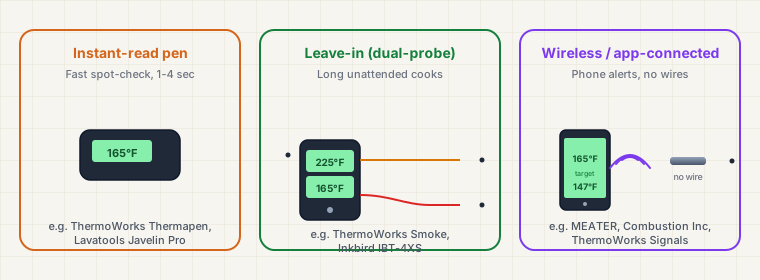
- Instant-read pen. A thin probe on a pivoting handle, 2 to 4 second read time, designed for quick spot-checks. Best at: confirming final doneness, checking thick cuts, testing oil temperature. Limits: cannot stay in a hot smoker; battery powers the display only. Price: $20 to $130. Examples: ThermoWorks Thermapen ONE ($109 to $129), ThermoWorks Thermapop ($35 to $40), Inkbird IHT-1P ($30 to $40), Lavatools Javelin Pro ($60 to $80), the budget-bin "AcuRite" or similar at $20.
- Leave-in (dual-probe). One or more heat-tolerant probes connected by a stainless braided wire to a base unit that sits outside the smoker. The probe stays in the meat for the full cook (often 6 to 14+ hours), the readout shows current temp, target alerts beep when you hit the mark. Best at: monitoring brisket, pork shoulder, ribs, or any unattended cook. Limits: wire can pinch under the smoker lid; probes wear out after 12 to 18 months of heavy use. Price: $50 to $200. Examples: ThermoWorks Smoke ($99) plus ThermoWorks Smoke Gateway WiFi add-on ($79), Inkbird IBT-4XS ($60), Inkbird IBT-6XS ($90), Maverick ET-733 ($80).
- Wireless / app-connected. A fully wireless probe (no wire to the base unit) or a wired base with WiFi / Bluetooth that pushes alerts to your phone. Best at: long unattended cooks where you want to leave the house; cooks where the smoker is far from your living space. Limits: requires apps, battery management, and trust in the wireless link; cost premium over wired leave-ins. Price: $80 to $300. Examples: MEATER ($80), MEATER Plus ($100), MEATER Block ($270), Combustion Inc Predictive Thermometer ($200), ThermoWorks Signals ($230) with Billows fan controller add-on ($79).
The four specs that actually matter
Spec sheets list dozens of numbers; only four affect how the thermometer feels in real use.
- Read speed. Premium instant-reads (Thermapen ONE) hit final reading in 1 to 2 seconds. Mid-tier (Thermapop, Javelin Pro) hit it in 3 to 4 seconds. Budget pens (under $25) take 6 to 10 seconds, long enough that the meat continues to cook in your hand while you wait. Speed matters most for fast cooks: burgers, steaks, chicken parts.
- Accuracy. Premium: plus or minus 0.5 to 1 F (about 0.3 to 0.5 C). Mid-tier: plus or minus 1 to 2 F. Budget: plus or minus 2 to 4 F. For meat doneness, plus or minus 2 F is fine; the difference between 163 F and 167 F is not perceptible. Tighter accuracy mostly buys peace of mind and confidence at the edges of safety thresholds.
- Temperature range. Most thermometers cover the food-relevant range (32 to 572 F / 0 to 300 C). The numbers that matter: lower bound (does it read at smoker temps of 225 F?), upper bound (does it tolerate brief exposure to grill grates at 600 F+?). For deep-frying or candy work, look for upper-range models (up to 932 F / 500 C).
- Water resistance. IP65 (splash-proof) is the minimum for a meat thermometer; you will spill juice on it. IP67 (immersion to 1 m) lets you rinse it under a tap without worry. Wireless probes with internal batteries (MEATER) need higher ratings since the probe sits fully in meat juices.
Secondary specs (number of probes, backlight, magnet, kickstand, calibration button) are nice-to-have but rarely change the buying decision.
Price tiers and what you get
What each tier actually buys, in both US and Canadian retail.
- $20 to $40 USD (CAD 25 to 55): Entry. Budget instant-reads (AcuRite, Habor, Generic Amazon brands), basic dial thermometers, single-probe leave-ins from Inkbird or Maverick. Accuracy plus or minus 2 to 4 F, read speed 6 to 10 seconds. Fine for occasional cooks; pros buy these as backup or to lend out.
- $40 to $80 USD (CAD 55 to 110): Mid. ThermoWorks Thermapop ($35), Lavatools Javelin Pro ($65), Inkbird IHT-1P ($35), Inkbird IBT-4XS dual-probe leave-in ($60). The sweet spot for most cooks; plus or minus 1.5 F accuracy, 3 to 4 second reads, durable enough for years of use.
- $80 to $130 USD (CAD 110 to 175): Premium. ThermoWorks Thermapen ONE ($109), MEATER ($80), MEATER Plus ($100), ThermoWorks Smoke ($99) with built-in fan-controller-ready output. Read speed 1 to 2 seconds, accuracy plus or minus 0.5 to 1 F, build quality lasts a decade with care.
- $130 to $300+ USD (CAD 175 to $400+): Professional. ThermoWorks Signals ($230) with Billows fan controller ($79), MEATER Block ($270), Combustion Inc Predictive Thermometer ($200), Fireboard 2 Drive ($200 to $250). Multi-probe, WiFi, fan-controller integration for hands-off cook automation. Aimed at competition cooks and pitmasters.
How to calibrate (ice-water and boiling-water tests)
Two simple tests verify your thermometer is reading accurately. Run them on every new thermometer, then once or twice a year, and any time a reading feels off.
- Ice-water test (the workhorse). Fill a glass with crushed ice, top with cold water, stir for 10 seconds, wait 30 seconds for thermal equilibrium. Insert the probe to the same depth you would use in meat (typically 1 to 1.5 in / 25 to 38 mm), avoiding the glass sides and bottom. The reading should be 32 F (0 C) within the unit's specified accuracy. This is the more reliable test because ice water always equilibrates at exactly 32 F.
- Boiling-water test (the altitude-sensitive one). Bring a pot of water to a rolling boil for 1 minute. Insert the probe, again avoiding pot sides. At sea level the reading should be 212 F (100 C). At elevation it reads lower: about 209 F (98 C) at 1,000 ft / 305 m, 207 F (97 C) at 2,000 ft / 610 m, 203 F (95 C) at 5,000 ft / 1,524 m, 200 F (93 C) at Denver's 5,280 ft altitude, 196 F (91 C) at Calgary or Albuquerque's higher elevations. Look up your local boiling point before running this test or you will think a perfectly good thermometer is off.
- Recalibration. Most digital thermometers have a calibration button or menu setting; press it while the probe is in ice water or boiling water at the known target temp. Analog dial thermometers have a hex nut under the dial face; rotate the dial while the probe is in the calibration medium until it reads the target. After recalibrating, run the other test (boiling if you started with ice) to verify both ends.
Common mistakes
- Probing too close to the bone. Bone conducts heat differently than meat and reads hotter than the surrounding flesh, giving false-high readings that make you pull meat early. Always probe the deepest part of the muscle, well away from any bone.
- Probing into fat or gristle. Fat insulates and reads cooler than the lean meat around it, giving false-low readings that lead to overcooking. The probe should be in the thickest part of the lean muscle, not buried in a fat cap or seam.
- Leaving an instant-read pen in a hot smoker. The probe tip tolerates high heat briefly, but the electronics in the handle do not. Sustained 225 F (107 C) exposure can fry the display and kill the unit. Use a leave-in probe for long cooks.
- Never calibrating. Even premium thermometers drift over time, especially after drops, dishwasher exposure (most are not dishwasher-safe), or extended high-heat use. A quick ice-water test once a season catches drift before it ruins a brisket.
- Trusting the bag thermometer built into the smoker lid. Lid-mounted dials are typically 25 to 50 F off the actual grate temperature. They read the dome air, not the cooking surface. Use a leave-in probe at grate level for the real cook temp.
- Pulling the probe out, then putting it back into a different spot. Each puncture loses a tiny amount of juice. Pick the spot, push the probe in once, leave it. If you must move it, push it deeper into the same channel instead of starting a new hole.
Reach for the target internal temps by cut on the Meat Smoking Temperature & Time Reference printable.
FAQ
What kind of meat thermometer does most home cooks need?
For most home cooks, the right answer is one good instant-read pen (think ThermoWorks Thermapen ONE, Inkbird IHT-1P, or Lavatools Javelin Pro) for grilling, plus a dual-probe leave-in (ThermoWorks Smoke or Inkbird IBT-4XS) for smoking. The instant-read confirms doneness; the leave-in monitors a long cook without lifting the lid. Wireless app-connected probes (MEATER, Combustion Inc, ThermoWorks Signals) are a luxury, useful when you cannot stay near the smoker but not essential for a good cook.
How accurate does a meat thermometer need to be?
Plus or minus 1 to 2 F (about 1 C) is the realistic standard for premium instant-reads (ThermoWorks Thermapen specifies plus or minus 0.5 F at 32 F to 212 F). Budget instant-reads typically run plus or minus 2 to 3 F. Leave-in probes run plus or minus 1.5 to 2 F at typical smoking temps. For meat doneness this is plenty: 165 F vs 167 F changes nothing in safety or texture. Accuracy matters most at low temps (smoking at 225 F) and at the upper food-safety thresholds (poultry at 165 F).
How do I calibrate a meat thermometer?
Ice-water test: fill a glass with crushed ice, top with cold water, wait 30 seconds, insert the probe to the same depth you would use in meat. It should read 32 F (0 C) within the unit's specified accuracy. Boiling-water test: bring water to a rolling boil, insert the probe. It should read 212 F (100 C) at sea level, but lower at elevation, water boils at about 209 F at 1,000 ft, 207 F at 2,000 ft, 203 F at 5,000 ft, 200 F at Denver's altitude. Recalibrate any time the readings drift more than the spec tolerance. Most digital thermometers have a recalibration button; analog dial thermometers have a hex nut under the dial.
Are wireless app-connected thermometers worth the premium?
For unattended overnight smokes, yes. For everything else, optional. The wireless category is dominated by MEATER (single fully-wireless probe, $80 to $130), MEATER Plus and Block (extended range), Combustion Inc Predictive Thermometer ($200, 8-sensor probe + predictive cook time), and ThermoWorks Signals + Billows (multi-probe with WiFi, $200 to $300). They let you stay in the house during a 14-hour cook and get push notifications on stalls and target temps. The downside is a 1 to 2 year battery / app dependency; the underlying meat probe is still the same thermistor as a $50 wired leave-in.
What is the difference between instant-read and leave-in probes?
Instant-read pens (ThermoWorks Thermapen, Inkbird IHT, Lavatools Javelin) read fast (2 to 4 seconds) and tolerate brief exposure to high heat, but are not designed to stay in a closed smoker for hours, the housing electronics will overheat. Leave-in probes (ThermoWorks Smoke, Inkbird IBT) have heat-tolerant wire leads from the meat probe out to a base unit; the probe and wire can ride in a 250 F smoker indefinitely while the readout sits outside. Use the right tool for each job: instant-read for quick checks and final doneness, leave-in for long unattended cooks.
Bottom line
If you can only buy one meat thermometer, get a premium instant-read pen (Thermapen ONE, Thermapop, or Javelin Pro). If you smoke regularly, add a dual-probe leave-in (Smoke or Inkbird IBT). Wireless app-connected probes solve the unattended-overnight-cook problem and nothing else; skip them until you actually need that solution. Calibrate every new thermometer with the ice-water test before first use, and recalibrate seasonally. The best thermometer in the world cannot help you if you probe near a bone or leave it sitting in a fat cap, so technique matters as much as the device.