Home Inventory Tracker
Add household items by category, track estimated replacement values, and build the insurance-ready inventory most claims adjusters ask for after a fire, flood, or theft.
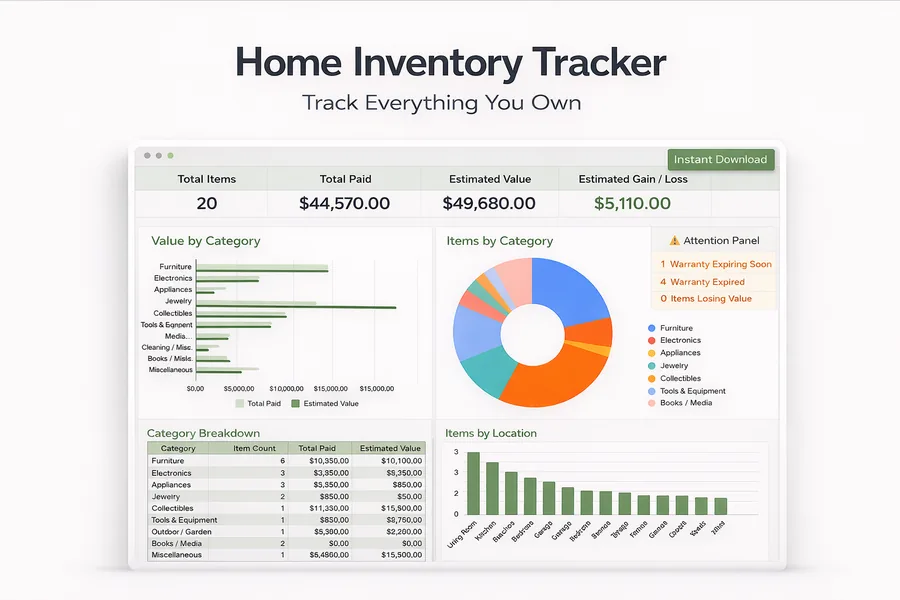
Quick estimator only, your list lives in this browser tab. For a permanent saved version with warranty and depreciation tracking, see the full tracker on Etsy.

Add items to your inventory
Enter each item, its category, quantity, and estimated replacement value. Your inventory totals update automatically.
How to use this tracker
Enter an item name, select a category, set the quantity, and enter the per-unit replacement value. Click "Add Item" to add it to your list. The tracker automatically calculates totals by category and your grand total. You can remove individual items with the × button, or clear everything and start over. Use the "Copy inventory as text" button to export a plain-text version you can paste into a document or email.
Tips for a complete inventory
- Use replacement value. What it would cost to buy the item new today, not the original purchase price or current resale value. This is what most insurance policies pay out.
- Walk every room with your phone. Film open closets, drawers, cabinets, and shelves before entering values. Video proof is faster than written documentation and accepted by most insurers.
- Catch the easy-to-miss stuff. Hand tools, sports equipment, musical instruments, holiday decorations, and stored seasonal gear. These categories often add up to thousands of dollars.
- Schedule riders for high-value items. For jewelry, art, collectibles, or firearms, add a separate insurance rider or floater. Standard policies often cap single-item payouts at $1,000–$2,500.
- Store a copy off-site. Email the inventory to yourself or save it to cloud storage so it survives a fire, flood, or theft that destroys the original.
Common mistakes
- Logging purchase price, not replacement cost. A 5-year-old laptop you bought for $1,200 may cost $1,800 to replace today. Use current market prices.
- Skipping clothing as "too tedious." Estimate by wardrobe section instead of garment-by-garment. A full adult wardrobe routinely runs $2,000–$8,000.
- Lumping high-value items into Other. Use specific categories so a claims adjuster can quickly match items to your policy line limits.
- Forgetting items in the basement, attic, or garage. Out-of-sight gear (tools, holiday decor, sporting equipment, generators) is often the difference between full and partial recovery.
- Letting the inventory go stale. Inventory you built three years ago is missing every purchase since. Update at least annually before policy renewal.
What to include in a home inventory
- Electronics: TVs, computers, phones, tablets, cameras, gaming consoles, audio equipment, smart home devices.
- Appliances: Refrigerator, washer/dryer, dishwasher, microwave, coffee maker, vacuum cleaner, small kitchen appliances.
- Furniture: Sofas, beds, mattresses, dressers, desks, dining table and chairs, outdoor furniture, shelving.
- Clothing: Estimate by wardrobe section rather than individual garments, a full adult wardrobe typically runs $2,000–$8,000 at replacement cost.
- Tools & equipment: Power tools, hand tools, lawn mowers, generators, ladders, outdoor power equipment.
- Preparedness gear: Generators, water storage, food storage, first aid supplies, communications equipment.
FAQ
How much personal property coverage do I need?
Most financial advisors recommend coverage equal to the full replacement cost of everything you own. Run through this tracker and compare the total to your current policy's personal property limit. Many renters are underinsured, the average renter underestimates their belongings by 30–50%.
What's the difference between actual cash value and replacement cost coverage?
Actual cash value (ACV) pays the depreciated value of your items, what a 5-year-old TV is worth used, not what a new one costs. Replacement cost coverage pays what it actually costs to buy a comparable new item. Replacement cost coverage costs more in premiums but provides significantly better protection.
Will my insurance company accept this inventory after a claim?
Yes, a detailed home inventory is exactly what claims adjusters ask for after a loss. The more specific your list (item names, approximate purchase dates, estimated values), the smoother the claims process. Video walkthroughs stored in cloud backup are also widely accepted.
Does this tool save my data?
No. This tracker runs entirely in your browser and does not transmit or store your data anywhere. Your inventory lives only in the current browser session. Use the "Copy inventory as text" button to export and save your list before closing the tab.
How often should I update my home inventory?
After any significant purchase, annually before renewing insurance, and after major life events (moving, marriage, inheritance). Even a rough update once a year dramatically improves your position in a claim compared to no inventory at all.
Ready to build your full inventory?
Move from a quick estimate to a complete, organized system you can keep and update anytime.
Save your inventory permanently, track warranties, and monitor value over time.
Get Full Tracker →