How to Use the 50/30/20 Budget Rule
A practical walkthrough of the 50/30/20 budgeting method: how to split your take-home pay, what counts as a Need vs a Want, and when to bend the rule to fit your life.

Quick steps
- Calculate your monthly take-home pay. Net amount after taxes and benefits. Multiply weekly paycheck × 4.33 or biweekly × 2.17. Add pre-tax 401(k) contributions back so they count in the 20% savings bucket.
- Calculate the three targets. 50% × take-home = Needs cap. 30% × take-home = Wants cap. 20% × take-home = Savings and extra debt payoff target.
- Sort current spending into Needs vs. Wants. Need = "if I lost my job tomorrow, I'd keep this" (rent, groceries, basic phone, health insurance). Want = lifestyle (restaurants, premium plans, subscriptions, luxury lease).
- Compare actuals to the targets. Most first-time users find Needs too high (typically 60-70% in expensive areas) and Savings too low. Identify the biggest single overage.
- Adjust one bucket per month, not all three. Cut one Want (downgrade a subscription, reduce takeout frequency) or attack one Need (refinance, downsize). Re-check ratios next month.
- Hit 20% Savings before optimizing further. If 20% isn't possible yet, aim for 10% as a stepping stone. The framework is a target, not a pass/fail, direction matters more than exact ratios.
What the 50/30/20 rule actually is
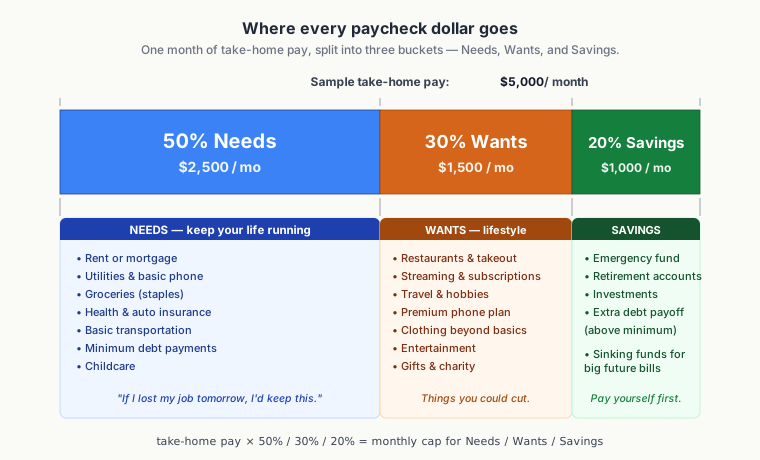
Popularized by Senator Elizabeth Warren in All Your Worth (2005), the 50/30/20 rule is a high-level budgeting framework rather than a detailed tracker. You take your monthly after-tax income and split it into three buckets:
- 50% Needs: Housing, utilities, groceries, basic transportation, insurance, minimum debt payments, childcare. The spending required to keep your life running.
- 30% Wants: Restaurants, subscriptions, travel, hobbies, clothing beyond basics, entertainment. The quality-of-life spending you could technically cut.
- 20% Savings and debt payoff: Emergency fund contributions, retirement, investments, and any debt payments above the required minimum.
The appeal is simplicity. You don't need 40 spreadsheet categories, and you don't need to log every coffee. Three buckets, three percentages, done.
How to calculate your take-home pay correctly
This is where most people go wrong on the first try. The rule is based on take-home (net) pay, not gross salary. Take-home is what lands in your bank account after:
- Federal, state or provincial, and local income tax
- Social Security and Medicare (or CPP and EI in Canada)
- Health insurance premiums paid by you
- Any pre-tax retirement contributions (see the note below)
Grab your most recent paystub and use the net amount. Multiply a weekly paycheck by 4.33 or a biweekly paycheck by 2.17 to get a monthly figure. If your income varies, average your lowest 3 months from the past year as a conservative baseline.
Retirement contribution nuance: If your 401(k), 403(b), or RRSP contributions come out pre-tax, they reduce your take-home pay. For clean math, add those contributions back to your take-home and count them in the 20% savings bucket. Otherwise your savings rate looks lower than it actually is.
What counts as a Need vs a Want
The trickiest part of 50/30/20 is sorting your expenses. Here's a practical rule: ask, "If I lost my job tomorrow and had to cut to survival mode, would I keep this?" If yes, it's a Need. If no, it's a Want.
- Rent or mortgage: Need. But the portion above a modest apartment for your area is functionally a Want. If you're in a luxury rental by choice, that's lifestyle.
- Groceries: Need. Restaurants and takeout are Wants, even if they replace cooking at home.
- Phone: Need at a basic plan (around $30–50). Premium plans and new device financing are Wants.
- Car payment and insurance: Need if you have no transit alternative. But a $700/month luxury lease when a reliable $300 used-car payment would do is partly a Want.
- Health insurance: Always a Need.
- Internet: Need for most people in 2026 (work-from-home, school, banking).
- Streaming, gym, subscriptions: Wants, even if they feel essential.
- Gifts and charity: Wants. Some people prefer to carve out a fourth bucket for giving, which is fine.
- Minimum debt payments: Need. Anything above the minimum is Savings/debt payoff.
Handling shared categories like groceries and transportation
Some categories include both Needs and Wants spending. Don't over-engineer this. A rough 80/20 estimate is more than accurate enough.
- Groceries: Staples go in Needs. Craft beer, specialty cheese, and prepared convenience foods can be split into Wants if your grocery bill is unusually high.
- Transportation: Fuel for commuting and essential driving is a Need. Road trips and weekend drives are Wants.
- Clothing: Replacing worn-out work clothes is a Need. Fashion shopping is a Want.
- Utilities: Base electric, gas, water are Needs. Premium cable packages are Wants.
The goal isn't accounting perfection. It's seeing roughly where your money goes and whether that matches your priorities.
When to adjust the split
The 50/30/20 rule works well for middle-income households in average cost-of-living areas. It breaks down in a few common situations:
- High cost-of-living areas: If rent alone is 40%+ of take-home in cities like New York, San Francisco, Toronto, or Vancouver, hitting a strict 50% Needs target may be impossible. A 60/20/20 or 65/15/20 split is more realistic until income grows or living costs drop.
- Aggressive debt payoff: If you have high-interest debt (credit cards, payday loans), flip the Wants and Savings buckets temporarily. Try 50/20/30 with the extra 30% going entirely to debt payoff. The math of high interest rates makes this pay off faster than conservative splits.
- Low income: When take-home is tight, Needs may take 70%+ no matter how carefully you cut. Save what you can (even 5%) and focus on income growth rather than beating yourself up over the split.
- High income: If you earn well above what you spend, you can push savings to 30%, 40%, or even 50% and shrink the other buckets. FI/RE households commonly run 30/20/50 or more aggressive splits.
- Irregular income: Freelancers, contractors, and commission-based earners should budget around a conservative baseline and treat high months as savings opportunities rather than normal income.
Common mistakes to avoid
- Using gross income: Inflates your targets so Wants and Savings look achievable when they aren't. Always use net pay.
- Forgetting irregular expenses: Car registration, annual insurance premiums, and holiday spending blow up budgets that ignore them. Divide these by 12 and include them in the relevant bucket.
- Counting employer 401(k) match as your savings: Only count money you set aside. The match is extra.
- Treating one bad month as failure: A car repair or medical bill will throw off any single month. Look at 3 to 6 month trends instead.
- Ignoring sinking funds: Predictable future costs (holidays, vacations, new tires, a replacement car) are easier to handle if you save a small amount each month rather than scrambling when they hit.
- Obsessing over sorting: If you're unsure whether to call something a Need or Want, pick one and move on. The framework is approximate by design.
How to track it month to month
A monthly 10-minute check is enough for most people. Pick a consistent review day (payday, or the 1st of the month) and do this:
- Open your bank and credit card statements for the previous month.
- Sort transactions into the three buckets (don't obsess over line items).
- Add up each bucket and calculate percentages against take-home pay.
- Compare to 50/30/20 targets and note which buckets are over or under.
- If you're over in Wants, look at 2 or 3 specific categories to trim next month.
- If you're under in Savings, set up an automatic transfer on payday so it happens before you spend.
Automation beats willpower. The single most effective move is scheduling automatic transfers to savings on your payday so the 20% never sits in your checking account where it can be spent.
Tools that help
FAQ
Who invented the 50/30/20 rule?
The 50/30/20 rule was popularized by Elizabeth Warren and Amelia Warren Tyagi in their 2005 book All Your Worth: The Ultimate Lifetime Money Plan. It was designed as a simpler alternative to detailed line-item budgets that many people start and abandon within a month or two.
Does the 50/30/20 rule work for low incomes?
The strict version struggles at low incomes because housing and food often take more than 50% of take-home pay, leaving little room for Wants or Savings. Use it as a direction rather than a target: save something every month even if it's 5%, and focus on growing income alongside cutting expenses. Use a tracker to see where there's room to trim, then reassess as income grows.
Should my 20% go to savings or debt payoff?
Both live in the same bucket. The standard sequence: build a $1,000–$2,000 starter emergency fund first, then put most of the 20% toward any debt with an interest rate above 8% (credit cards, payday loans, some student loans). Once high-interest debt is gone, split the 20% between retirement, a full 3–6 month emergency fund, and other goals. Low-interest debt (most mortgages, subsidized student loans) doesn't need to be rushed.
Is the 50/30/20 rule better than zero-based budgeting?
Different tools for different people. Zero-based budgeting assigns every dollar to a specific category, which gives more control but takes more time and can feel restrictive. The 50/30/20 rule is lighter-touch and faster to maintain. Many people start with 50/30/20 for the framework, then graduate to zero-based when they want more detail, or blend the two by using 50/30/20 as an overall target with lightweight category tracking inside each bucket.
How often should I review my 50/30/20 budget?
Once a month is ideal for most people. A quick 10-minute review on payday or the 1st of the month is enough to sort transactions into the three buckets and spot problems. More frequent reviews (weekly) work for people new to budgeting or in aggressive debt payoff. Quarterly reviews are fine once your system runs on autopilot with automatic transfers.
Does this work for couples or families?
Yes. Combine both incomes into take-home pay and combine expenses. Decide up front whether you're budgeting as one pool ("ours") or two pools with shared expenses, and stay consistent. Couples with very different incomes sometimes contribute proportionally rather than equally to shared expenses, which works fine inside the 50/30/20 framework.
Bottom line
The 50/30/20 rule is a simple, durable framework: 50% of take-home pay for essentials, 30% for lifestyle, 20% for savings and extra debt payoff. It won't fit perfectly at very low or very high incomes or in expensive cities, but as a target to work toward, it beats having no plan at all. Use take-home pay, keep sorting practical, automate the savings transfer, and review monthly. That's the whole system.
Want a permanent dashboard instead of a monthly spreadsheet?
If the 50/30/20 framework clicks for you and you want a ready-to-use Google Sheets version with live category tracking, monthly and yearly charts, and a clean dashboard, the Smart Budget Dashboard is a one-time purchase.
- Auto-calculated 50/30/20 targets from your income
- Category-level tracking with trend charts
- Monthly and yearly views in one sheet
- Works on phone, tablet, and desktop
Keep your budget in one place and see the numbers update as you spend.
Get the Smart Budget Dashboard →One-time purchase • Instant access