Towing Capacity Explained
A plain-English walk-through of every towing weight rating, GVWR, GVW, GCWR, GAWR, GTW, Tongue Weight, Pin Weight, Curb Weight, Dry Weight, and Payload, so you can read your door-jamb sticker with confidence and hook up a bumper-pull, fifth-wheel, or gooseneck trailer without second-guessing the numbers.

Quick summary
Typical capacities: most SUVs tow 3,500–6,000 lbs, half-ton trucks 8,000–13,000 lbs, heavy-duty trucks 15,000–35,000+ lbs. Read the sticker on your driver-side doorjamb, not the marketing brochure, the brochure number assumes an empty cab and a specific trim.
What is towing capacity?
Towing capacity is the maximum weight your vehicle is engineered to safely pull behind it, set by the manufacturer based on engine, transmission, cooling system, frame, brakes, axles, and tyres. It is not a number you can “adjust” by buying a bigger hitch, the hitch is only one link in a chain where the lowest-rated component determines the real limit.
How the weight ratings fit together
These five equations show how the common weight terms relate. Skim them once and the rest of the guide will click into place.
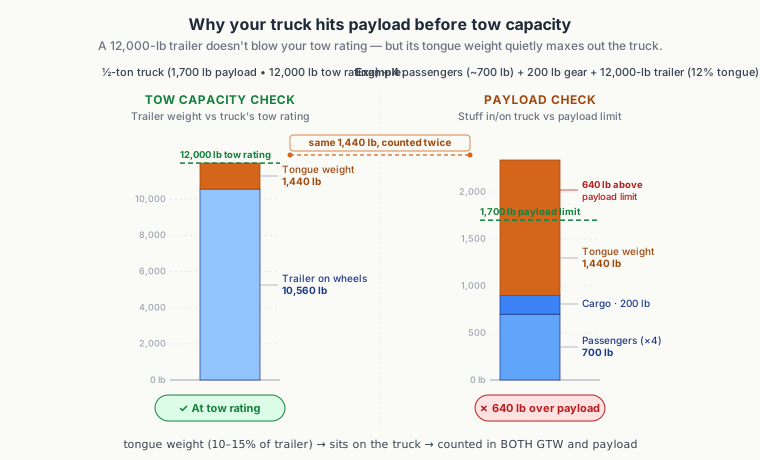
Notice that tongue weight appears twice, it lives on the trailer (as part of GTW) and counts against your vehicle's payload at the same time. That’s why a trailer that’s well under your tow rating can still blow past your payload limit once you add passengers and cargo inside the cab.
Quick-reference table
Ten weight terms you will see on stickers, brochures, and trailer spec sheets. Click any abbreviation to jump to its full explanation below.
| Term | Full name | What it describes |
|---|---|---|
| GVWR | Gross Vehicle Weight Rating | Maximum total weight of a single vehicle (or trailer) with everything loaded. |
| GVW | Gross Vehicle Weight | Actual total weight of the vehicle as currently loaded, measured, not rated. |
| GCWR | Gross Combined Weight Rating | Maximum total weight of the tow vehicle and the trailer, fully loaded. |
| GAWR | Gross Axle Weight Rating | Maximum weight any single axle (front or rear) can support. |
| GTW | Gross Trailer Weight | Actual total weight of the trailer with cargo, measured, not rated. |
| TW | Tongue Weight | Downward force a bumper-pull trailer applies to the hitch ball. |
| PW | Pin Weight | Downward force a fifth-wheel or gooseneck trailer applies to the truck bed. |
| Curb weight | — | Weight of the empty vehicle with standard fluids and a full tank. |
| Dry weight | — | Weight of the empty vehicle without fluids, fuel, or options. |
| Payload | — | Total weight of everything you add: passengers, cargo, and tongue or pin weight. |
Every weight rating, one at a time
GVWRGross Vehicle Weight Rating
The maximum allowable total weight of the vehicle itself, fully loaded. It includes the vehicle’s own weight, all fluids, every passenger, every bag of cargo, and anything resting on the hitch. GVWR is set by the manufacturer and printed on the driver’s door-jamb sticker along with the date-of-build information.
GVWGross Vehicle Weight
The actual measured total weight of your vehicle right now, curb weight plus every passenger, every piece of cargo, every accessory, and the tongue or pin weight from anything hitched behind. GVW is a description, not a rating: it’s whatever the truck weighs on a scale at this exact moment.
GCWRGross Combined Weight Rating
The maximum allowable weight of the tow vehicle and trailer combined when both are fully loaded. This is the number that matters when you hook up and drive: vehicle + passengers + cargo + trailer + everything in the trailer must come in under GCWR.
GAWRGross Axle Weight Rating
The maximum weight any single axle can support. Most vehicles have a front GAWR and a rear GAWR, and they are often different numbers. Load distribution matters: a heavy tongue weight shifts weight onto the rear axle (sometimes even lifting the front wheels), which can tip you over the rear GAWR long before you hit total payload.
GTWGross Trailer Weight
The actual measured total weight of the trailer with cargo loaded and ready to roll. GTW is a description, not a rating, it’s whatever the trailer weighs right now. The trailer’s own GVWR sets the ceiling; GTW is what you’re really pulling today.
TWTongue Weight
The downward force the loaded trailer applies to the hitch ball. The healthy range is 10–15% of GTW. Too little and the trailer can sway dangerously at highway speeds; too much and you overload the rear axle, lighten the steering wheels, and risk trailer-induced brake fade on grades.
PWPin Weight
The downward force a fifth-wheel or gooseneck trailer applies to the tow vehicle at the kingpin (fifth-wheel) or ball coupler (gooseneck) mounted in the truck bed. The healthy range is 15–25% of GTW: noticeably higher than tongue weight, because the load sits over or just ahead of the rear axle rather than hanging off the back bumper. That geometry improves stability and ride, but it also puts a much larger share of the trailer’s weight directly onto the truck’s payload and rear GAWR.
CurbWeight
The weight of the vehicle as it sits parked at the dealership: all standard equipment, a full tank of fuel, and a full load of required fluids, but no passengers, cargo, or aftermarket accessories. Curb weight is the starting point for calculating payload (GVWR − curb weight ≈ payload).
DryWeight
The weight of a vehicle or trailer with no fluids, no fuel, no propane, no water, and often no factory-optional equipment. It’s the number you’ll see in RV and trailer spec sheets, and it’s almost always lighter than what rolls out the door.
PayloadWhat the vehicle carries
Everything you add to the vehicle after it leaves the factory: passengers, cargo, the weight of a hitch and bike rack, and the tongue or pin weight from a trailer. Payload capacity is listed on the yellow door-jamb sticker as “Combined weight of occupants and cargo” and is usually a smaller number than most people expect, especially on a ½-ton truck once you add a 2,000 lb+ fifth-wheel pin weight.
Where to find these numbers on your vehicle
Open the driver’s door and look at the B-pillar (the metal post between front and rear doors). You’ll see a printed or embossed sticker, usually white or yellow, with the vehicle identification number, tyre pressures, and the critical weight ratings: GVWR, GAWR Front, GAWR Rear, and the combined weight of occupants and cargo (your payload capacity).
The towing capacity itself is usually not on this sticker, for that, open the owner’s manual and find the table that lists towing capacity by trim, engine, axle ratio, and tow package. Your exact configuration matters: two trucks that look identical on the lot can have towing ratings that differ by 3,000 lb.
Can your vehicle tow a trailer at all?
Almost any modern vehicle can pull something, but the useful question is what you can safely pull for how long. Check these four things in order:
- Manufacturer tow rating. If your owner’s manual lists a non-zero tow capacity for your specific trim and package, you’re allowed to tow up to that number. If it says “not rated for towing,” stop here.
- Hitch class. Class I (up to 2,000 lb) and Class II (up to 3,500 lb) cover most cars and crossovers. Class III–V (up to 20,000 lb) are for trucks and full-size SUVs. The hitch rating caps the trailer weight regardless of what the vehicle itself is rated for.
- Brakes. Most jurisdictions require trailer brakes once the trailer exceeds 1,500–3,000 lb loaded. If you’re towing anything in that range, plan on a brake controller and trailer-brake-equipped trailer.
- Payload reality-check. Subtract the expected tongue weight plus passenger and cargo weight from the payload sticker. If the number is negative, you’re over before you even leave the driveway.
Can you increase towing capacity?
You cannot raise the manufacturer’s rating itself, it’s locked to the engine, transmission, frame, and brakes that came on the vehicle. What you can do is make the real-world rig safer and closer to its rated limit.
- Weight-distribution hitch. Transfers tongue load from the rear axle to the front axle and the trailer axles, restoring level stance, steering feel, and headlight aim. Often required by the manufacturer above 5,000 lb trailer weight.
- Sway-control bars or integrated anti-sway hitch. Dampens side-to-side motion from crosswinds and passing trucks. Highly recommended on long travel trailers.
- Brake controller. Synchronises trailer brakes with the vehicle brakes. Modern trucks with factory tow packages include this; older or lighter vehicles usually need an aftermarket unit.
- Helper springs or airbags. Level the rear end under heavy tongue weight. They do not raise GVWR or GAWR, they just keep the truck sitting level inside its existing limits.
- Transmission and engine cooling. Auxiliary transmission coolers (often part of a factory tow package) let the drivetrain run all day under load without derating.
Verify your specific rig with the Towing Capacity Checker.
Pre-tow safety checklist
Run through this before every tow trip, it’s what separates a relaxed drive from a white-knuckle one.
- Loaded trailer weight (GTW) confirmed at or below vehicle towing capacity and trailer GVWR.
- Loaded vehicle weight (GVW) confirmed at or below GVWR, ideally checked on a CAT scale.
- Tongue weight between 10–15% of GTW (bumper-pull) or pin weight 15–25% of GTW (fifth-wheel / gooseneck), measured not estimated.
- Passenger + cargo + tongue or pin weight confirmed at or below payload capacity.
- Front and rear axle loads confirmed at or below GAWR (watch the rear especially with heavy tongue or pin weight).
- Tyre pressures set to the loaded specification on both vehicle and trailer.
- Safety chains crossed under the coupler, breakaway cable attached to the vehicle (not the hitch).
- All trailer lights working: brake, turn, running, and emergency flashers.
- Brake controller tested at low speed before the first highway entrance.
- Coupler fully seated and locked on the ball, weight-distribution bars (if used) engaged.
- Mirrors extended or towing mirrors fitted for a full view past the trailer.
Frequently asked questions
What’s the difference between towing capacity and GCWR?
Towing capacity is the maximum weight that can hang behind your vehicle as a trailer. GCWR is the maximum total weight of vehicle and trailer combined. Towing capacity is usually calculated from GCWR minus the loaded weight of the vehicle, meaning the real-world trailer limit drops as you add passengers and cargo to the truck.
Why is my truck’s payload rating so much lower than I expected?
Payload equals GVWR minus the vehicle’s actual curb weight, and modern trucks have grown heavier with crew cabs, four-wheel drive, big wheels, and luxury equipment. A crew-cab 4x4 ½-ton truck that lists 12,000 lb towing capacity often has only 1,400–1,700 lb of payload, which fills up fast with four passengers, gear, and a heavy tongue weight.
Does the hitch rating limit my towing capacity?
Yes. Every component in the towing chain, vehicle, hitch receiver, drawbar, ball, and coupler, has its own rating. You’re limited by the lowest-rated component. A 14,000 lb receiver with a 6,000 lb ball mount is a 6,000 lb rig. Check the stamping on each piece.
What happens if I exceed towing capacity or GCWR?
Short-term: overheated transmission, glazed or burned-out brakes, bent frames under sudden loads, and dramatically longer stopping distances. Long-term: voided drivetrain warranty, higher insurance exposure in an at-fault accident, and premature wear on the tyres, brakes, and rear axle. The closer you are to your limits, the less margin you have when something goes wrong.
Can I tow closer to the limit on flat ground?
Tow ratings are tested under mixed conditions. Flat highway touring at 55–65 mph with moderate temperatures is the friendliest environment. But add altitude, summer heat, grades, or headwinds and your effective safe capacity drops. A common rule among experienced tow operators: plan for 80% of rated capacity under normal conditions, 70% if any of those variables are in play.
How accurate is a trailer manufacturer’s dry weight?
Dry weight is a spec-sheet number, not a real-world weight. Once you add battery, propane, fresh water, fuel, optional equipment, and the cargo you actually carry, a travel trailer can run 500–1,500 lb heavier than its dry spec. Size your tow vehicle to the trailer’s GVWR, not its dry weight.
Do I need trailer brakes?
Most US states require trailer brakes once the loaded trailer exceeds 1,500–3,000 lb; Canadian provinces typically start at 1,400–2,000 kg. Even below the legal threshold, trailer brakes dramatically shorten stopping distance, a non-braked 3,000 lb trailer behind a 5,000 lb truck can double your panic-stop distance.